Caregiver hugging senior man at home

Your life.
Your care.
Your people.

Customize your care! If you’re eligible for Medicaid and need support, you may be able to stay home and hire your own caregivers–even friends or family! It’s a great option called self-directed care, and we’re here to make it happen for you.

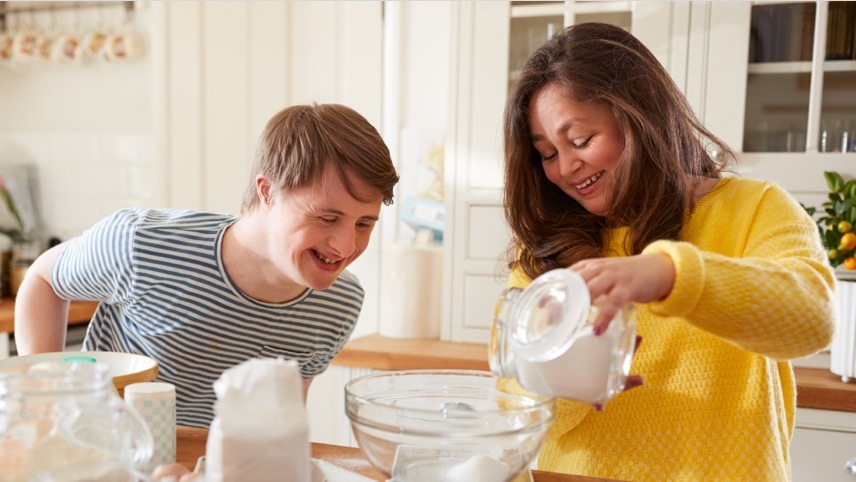
Boy with Down syndrome and his caregiver baking in the kitchen at home.

Self-directed care puts you in the driver’s seat. Decide where you receive care and who provides it. Got a friend or relative who’s already helping you? Great! Let’s see if we can make it official. Looking to hire someone else? We’ll get you set up and make sure you dot the I’s and cross the T’s.

Interested in finding out if self-directed care is right for you or your loved one?

“[Self-direction] means independence for me. There was stuff I wanted to do but I couldn’t do because I didn’t have anybody here with me. My building has steps, and I could barely make it down the steps or walk the two blocks to the park. It gave me my independence back.”

– Terry S., self-direction participant, New York, New York

“Before [self-direction programs] — both here in New York and around the country — many families did this work without pay, balancing care for loved ones with impossible financial pressure. Now, I can focus on caring for my mother instead of worrying about paperwork or payments, and she can remain at home, cared for by someone she trusts in the place where she feels most comfortable.”

Elena T., full-time primary caregiver for her mother, Brooklyn, New York

“What [makes] my role truly rewarding is the direct impact that I have with the consumer — so, on a daily basis, guiding him through certain tasks and so on. And that’s really [profound] to me. I never thought I would have such an impact … he’s quite happy when he can do certain thing[s]. It’s truly rewarding to me.”

– Tae S., caregiver, New York, New York

“I wanted to be able to take care of my brother and ensure his safety while we’re at home. He is handicapped, so he needs a lot of assistance. I’d rather me than someone else that I don’t know who’s coming into our house. Before [self-direction], we would only get a certain amount of time with other nurses that used to come in because he’s been with different programs before, since he was born. But now it’s consistent. He always has someone to care for him. There’s always someone in the house and it’s enhanced his motor skills, things like that. So it’s made a huge impact.”

Faith W., caregiver for her brother, Queens, New York

“[Self-direction] means independence for me. There was stuff I wanted to do but I couldn’t do because I didn’t have anybody here with me. My building has steps, and I could barely make it down the steps or walk the two blocks to the park. It gave me my independence back.”

– Terry S., self-direction participant, New York, New York

“A lot of people put us all in the same bubble: if you meet the level of care required for a nursing facility waiver, then you’re assumed to be incapable. You’re seen as a patient, not a person. And yet so many of us work, own our homes, and have families. We deserve that right to choose.”

Maria M., self-direction participant, Ohio

“Me being her caregiver is everything really … To be able to do this for my mom and help her out like I can … and at the same time, taking a little bit of the financial burden off me by getting paid to do it, we’re very blessed.”

– Stephen H., caregiver for his mom, Long Island, New York

“It’s a very, very important program to have because talking about my brother-in-law, he can’t talk, he can’t walk, he can’t be independent for himself.  I decided to work for my brother-in-law because he’s my friend. I see him every day. He’s with me almost like every day. So I decided to help him because he needs help for everything. So I decided to work for him. That’s very important for me.”

Jesus M., caregiver for his brother-in-law, Albany, New York

“You don’t have to be so stressed out financially, because all the time that you’re doing [caregiving], you might be tied [up and unable to take] another job … it helps out so much.”

Melony Z., caregiver for her mother, Bronx, New York

“She was in a nursing home because she had surgery. She was there for three months … but when she came out of the nursing home, she didn’t get [any] help, no assistance, anything. And she fell like 2 times. So that scared me when she when she fell. I’m like, wow, why is nobody giving you any assistance? She needs assistance.”

Kenya H., caregiver for a family friend, Bronx, New York

“A lot of [participants] don’t have a supportive family or friends. So being part of these people’s lives to me is a plus because they start really looking forward to seeing you. And it just, it really makes an impact on their life.”

– Karin Schuttig, caregiver, Amsterdam, New York

“The in-home, or self-directed care, allows [my son] to have more freedom because he can choose where he wants to go, what he wants to do, when he wants to do it. We work together to try to accomplish that.”

– Jack, father of self-direction participant, Arkansas

“From my view, I know I’m more comfortable in my house than an institution.”

– Rob, self-direction participant, Arkansas

“The man never left the house … he was always with me. There were only a few times that he ended up in the hospital, but we were always able to take him home at the end of that. He was able to be home for holidays, with the kids, grandchildren. … We had quality of life. We had him home. That’s the important take from this. … There’s a lot to be said for patient care at home. You get the care and the love, and that makes a big difference.”

Maureen H., designated representative for her late husband, Cohoes, New York

Caregiver and elderly woman in a wheelchair smiling at the park

Long-term care is stressful. Really stressful.

Loss of independence, worries about quality of care, financial pressure, limited personal space and privacy, loneliness, emotional strain, fear of neglect or abuse, and mountains of paperwork and bureaucracy … it’s no wonder people want to take back control. Every one of these concerns can be eased by self-directed care, and we want to get you there, as quickly and simply as possible.

Over nearly a quarter of a century, we’ve helped hundreds of thousands of people stay in their homes and receive support from caregivers that they choose, and hire with program funds.

Caregiver hugging girl with Down syndrome

If you’re currently caring for someone, or you know someone you would like to care for, we can set you up as their employee and make it easy to stay on top of the boring and often confusing paperwork. You’ll get to spend more of your time doing meaningful work for the people you care about.  

Interested in learning if self-directed care is right for you or your loved one?

Man and woman chatting in a conference room

We’re the trusted financial management services provider for 50 programs in 18 states (and counting). Once case managers and members agree on self-direction, we deliver services and tools to both, to keep things running smoothly. We focus on the admin, so you can focus on your members.

Find out how we can help your program run more efficiently

50

Self-Directed Program Partners

700K+

Participant & Caregiver Relationships

$10Bn+

Goods and Services Payments

Still have questions?

Whatever your situation, we’d love to chat about how we can make it better, together.

Let’s Chat

A disabled young man and his two friends smiling